

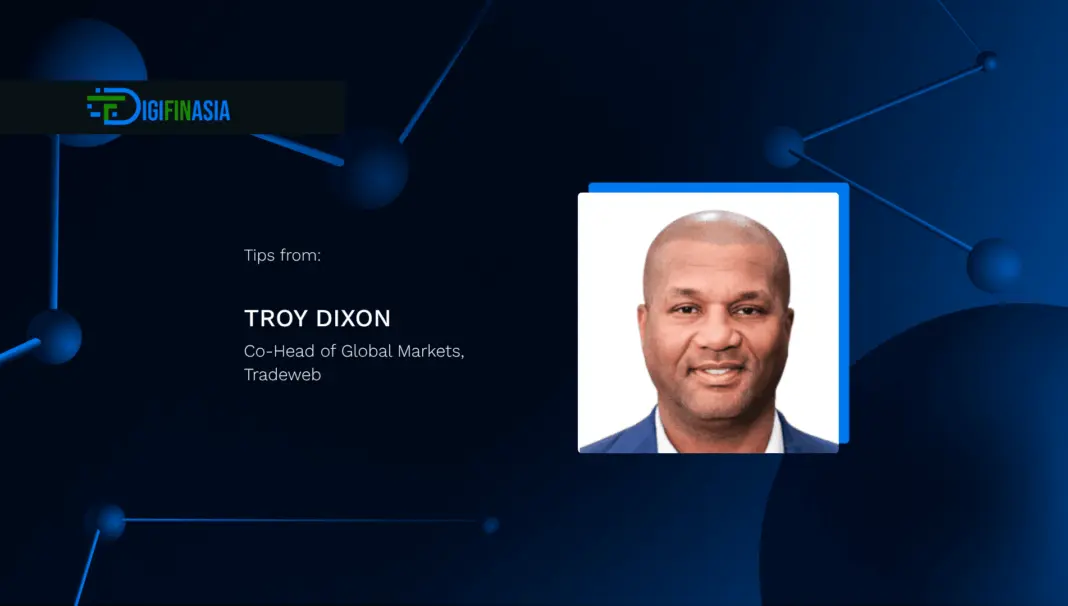
DigiFinAsia.net scrutinizes a corporate thesis on liquidity sourcing, execution risk management and cross‑product coordination in fixed income markets.
Algorithmic trading in fixed income is being recast not just as a tool for faster, cheaper execution, but as an “intelligence layer” that helps institutions source liquidity, manage execution risk and coordinate trades across products.
That is the core argument from Troy Dixon, Co-Head of Global Markets, Tradeweb, who sees the market moving from single‑dealer algo tools towards integrated, multi‑dealer environments enhanced by analytics and AI as su
- That electronification has reached an “inflection point.”
- That multi-dealer algo workflows are now central to best execution, with an inferred claim linked to cross-asset execution.
- That AI is materially changing how traders interact with the rates market.
DigiFinAsia.net examines the assertion using public data and market commentary to evaluate the claims.
-
The “inflection point” idea
Argument: Dixon believes recent volatility has pushed institutional investors “further into electronic workflows”, marking an inflection point where algo execution is now central to how liquidity is formed and managed in rates. He cites Coalition Greenwich data showing dealer-to-client electronic trading volume in the US rates market at 58% in March 2026, up from 48% in 2021, as evidence of a “continued upward trajectory of steady electronification”.
What the data shows: The direction is clear: electronic protocols now account for a majority of dealer-to-client activity in U.S. rates, with steady gains since 2021. Platform data underscores scale: Tradeweb reported $1.62tn average daily volume (ADV) in rates in August 2026, with $282.5bn in US government bonds and $553bn in swaps/swaptions of one year or more.
Caveats: The 58% figure is a snapshot for a single month and product set; it does not break out protocols (RFQ vs CLOB), tenors, or odd-lot vs benchmark trades, all of which matter for “liquidity formation”. ADV growth can mask concentration: a large share of electronic volume still flows through a handful of platforms and dealers, especially in swaps and inflation products.
Bottom line: Electronification in rates is advanced and still growing, but calling it an “inflection point” depends heavily on which products and protocols you look at.
-
The multi-dealer algo workflows idea
Argument: Dixon argues the market is shifting from “single-dealer algorithmic offerings” to “integrated, multi-dealer environments” where clients access a range of dealer strategies within one ecosystem. In this view, best execution is no longer a point-in-time outcome but a process that “unfolds gradually across multiple liquidity sources”, with algos used to execute over defined time horizons using quantitative logic.
What the data shows: Multi-dealer RFQ is now standard in many rates products, and dealers increasingly expose algo strategies (time-slicing, participation-rate, adaptive) within those workflows. Tradeweb’s own volumes suggest substantial usage of electronic protocols across rates, consistent with more systematic, repeatable execution.
Caveats: “Integrated, multi-dealer” often still means separate dealer relationships and credit lines, with the platform acting as aggregator rather than a truly unified liquidity pool. Cross-dealer algo usage can be constrained by:
- Dealer-specific credit and balance-sheet limits
- Protocol fragmentation (SEF RFQ, CLOB, voice/hybrid)
- Different TCA, pre-trade models and parameter sets across dealers
Bottom line: Multi-dealer algo access is real and growing, but the “single ecosystem” framing glosses over the operational and credit frictions that keep many workflows effectively siloed.
-
Cross-asset execution: coordinated or just adjacent?
Inferred argument: Dixon says traders are “not confined to single product silos”, expressing relative-value views across U.S. Treasuries, interest rate swaps, inflation swaps and mortgages, and requiring “coordinated execution across products and protocols”. He points to “smart order routing, real-time analytics and multi-leg execution tools” as evidence that execution is becoming more integrated.
What the data shows: Relative-value trades that span Treasuries and IRS (and sometimes inflation swaps) are common among macro and relative-value funds. Platforms and dealers do offer multi-leg tools and analytics that reference multiple rates products.
Caveats: True cross-asset, cross-protocol execution is still limited by:
- Different clearing and margin regimes (e.g., futures vs swaps vs cash bonds)
- Benchmark windows and auction calendars that force staggered execution
- Liquidity gaps in inflation swaps and mortgage products, especially off-the-run
Many “multi-leg” workflows are still manually coordinated by traders and risk teams, with algos used leg-by-leg rather than as a single optimized strategy.
Bottom line: Cross-asset thinking is widespread; fully integrated, algorithmic cross-product execution is still partial and product-dependent.
-
Cross-asset execution: coordinated or just adjacent?
Inferred argument: Dixon says traders are “not confined to single product silos”, expressing relative-value views across U.S. Treasuries, interest rate swaps, inflation swaps and mortgages, and requiring “coordinated execution across products and protocols”. He points to “smart order routing, real-time analytics and multi-leg execution tools” as evidence that execution is becoming more integrated.
What the data shows: Relative-value trades that span Treasuries and IRS (and sometimes inflation swaps) are common among macro and relative-value funds. Platforms and dealers do offer multi-leg tools and analytics that reference multiple rates products.
Caveats: True cross-asset, cross-protocol execution is still limited by:
- Different clearing and margin regimes (e.g., futures vs swaps vs cash bonds)
- Benchmark windows and auction calendars that force staggered execution
- Liquidity gaps in inflation swaps and mortgage products, especially off-the-run
Many “multi-leg” workflows are still manually coordinated by traders and risk teams, with algos used leg-by-leg rather than as a single optimized strategy.
Bottom line: Cross-asset thinking is widespread; fully integrated, algorithmic cross-product execution is still partial and product-dependent.
What comes next
Dixon’s outlook — more algo adoption, more multi‑dealer participation, greater cross‑asset integration, and “algo liquidity hubs” enhanced by AI — is directionally consistent with the data.
However, the pace and shape of that evolution will be set less by platform vision than by:
- Market structure and regulation: SEF rules, clearing mandates, and benchmark reforms
- Credit and balance-sheet constraints: which dealers can warehouse risk and in which products
- Data and model quality: whether pre-trade and execution models are robust enough to be trusted in stress
For institutional investors, the practical question is not whether algo trading in rates is “smarter than ever”, but where the intelligence actually lives today — in specific tools, protocols and workflows — and where it remains aspirational.