

Vietnam gaming studios, Philippine BPOs, Singapore hubs tackle payment fragmentation, multi-entity compliance via integrated workflows, AI, stablecoins.
For Asian small- and medium- sized enterprises (SMEs) pursuing cross-border growth, Fintech has transitioned from being peripheral tools into a part of mission-critical infrastructure.
These businesses, spanning Vietnam’s mobile gaming studios, Filipino business process outsourcing (BPO) agencies, and Singapore’s digital service hubs, now grapple with fragmented payments, multi-entity compliance, and high-velocity global transactions that outpace traditional banking. Recent industry observations underscore this shift, as SMEs seek integrated platforms to unify workflows, treasury functions, and regulatory adherence amid rising operational complexity.
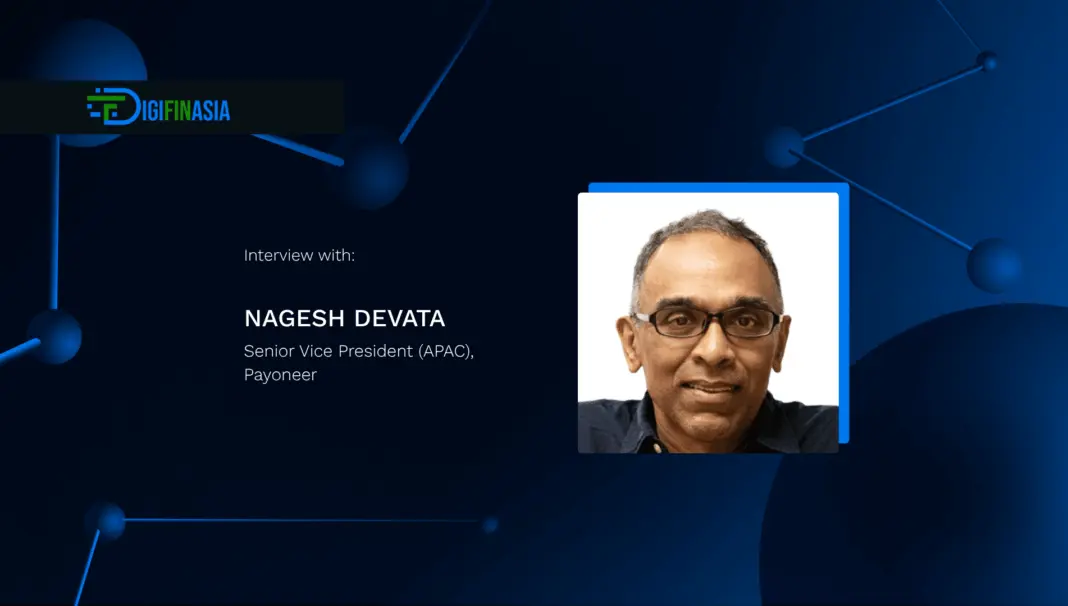
In this Q&A with DigifinAsia, Nagesh Devata, Senior Vice President (APAC), Payoneer, shares insights drawn from frontline observations of SME expansion challenges.
DigifinAsia: How has the perception and role of Fintech changed for Asian SMEs pursuing international expansion?
Nagesh Devata (ND): Across Asia, SMEs are no longer thinking of fintech as a nice-to-have; it is fast becoming the backbone of how they operate internationally.
What were once emerging tools, from cross-border payment solutions to financial workflow platforms, are now integral infrastructure enabling firms to scale beyond a single market.
For SMEs expanding globally, the challenge has evolved:
- It is no longer simply about accepting overseas payments, but about building a cohesive financial ecosystem that supports end-to-end cross-border operations.
- Rather than relying on fragmented tools, SMEs are turning to integrated fintech solutions that bring together payments, compliance, treasury, and workflows—enabling greater visibility, control, and scalability.
Fintech is no longer a set of standalone tools, but a strategic financial stack underpinning international growth.
DigifinAsia: What specific challenges do Asian SMEs face in cross-border operations, particularly in digital sectors?
ND: As SMEs expand across borders, financial complexity is increasing. Many businesses now operate across multiple platforms, marketplaces, and providers, creating fragmentation that extends beyond traditional banking relationships. This is particularly evident in high-growth digital sectors across Asia.
- Vietnam’s mobile gaming studios, for example, generate significant overseas revenue while managing multi-source inflows from app stores and ad networks, alongside global user acquisition spend.
- In the Philippines, SME BPOs and virtual assistant agencies handle high-frequency cross-border payments across clients in the US, Europe, and Asia, often without fully integrated systems.
- In Singapore, digital marketing and IT service providers are increasingly operating as regional hubs, managing cross-border clients, vendors and entities simultaneously.
At the same time, access to financial data is no longer the main issue. SMEs now have more information than ever, but are often overwhelmed by disconnected systems. As expectations shift toward always-on, automated operations, many still rely on manual processes, limiting efficiency and growth. Competitive advantage is no longer defined by payment access alone, but by how effectively businesses connect systems and act on insights across markets.
DigifinAsia: How does managing multi-entity operations factor into SME growth, and what solutions help?
ND: As SMEs expand internationally, their operating structures become more complex.
Many establish multiple entities or operational footprints across jurisdictions to better serve customers, manage costs, and optimize financial flows. For example, a Vietnam-based SME may set up an entity in Singapore or Hong Kong to access international clients more easily, while a Philippine-based agency may structure operations across markets to manage global payments more efficiently.
These setups enable growth, but also introduce added complexity across payments, compliance, and financial management. Managing multiple entities involves navigating different currencies, regulatory requirements, banking relationships, and reporting standards — often across disconnected systems.
Without the right infrastructure, this can lead to inefficiencies, limited visibility, and increased administrative burden.
To address this, fintech providers are enabling businesses to centralize and streamline financial operations across entities. This includes:
- consolidating payment flows
- improving reconciliation
- enhancing oversight across markets
As a result, Asian SMEs are in a better position to maintain control, reduce friction, and scale more efficiently. Collaboration across the ecosystem is becoming increasingly important. Incorporation services, accounting platforms, and compliance specialists are working more closely with payments providers to support SMEs across their growth journey.
DigifinAsia: In your opinion, what emerging technologies and future trends will shape cross-border fintech for Asian SMEs?
ND: New technologies are shaping the future of cross-border operations.
- AI is helping automate workflows, improve accuracy, and support better decision-making, from cash flow forecasting to anomaly detection. For fast-scaling sectors such as mobile gaming, where cash flow timing impacts user acquisition, or BPO and VA agencies managing contractor payments at scale, these capabilities are becoming critical to maintaining operational speed and competitiveness.
- At the same time, digital payment rails such as stablecoins are expanding cross-border options, offering faster processing, greater transparency, and potentially lower costs. Fintech is increasingly embedded into the core of business operations. Payments, workflows, compliance, and integrations are no longer separate functions but part of a unified system supporting daily activities.
SMEs that adopt integrated, modular fintech ecosystems are better positioned to scale. The role of fintech in supporting SMEs will continue to grow: Advances in AI, blockchain-enabled payment systems, and multi-market infrastructure will further transform how businesses operate globally.
As fintech evolves, it will continue to reshape how Asian SMEs scale internationally, turning what were once optional tools into essential components of global business operations.
DigifinAsia thanks Nagesh Devata for sharing his professional insights with our readers.